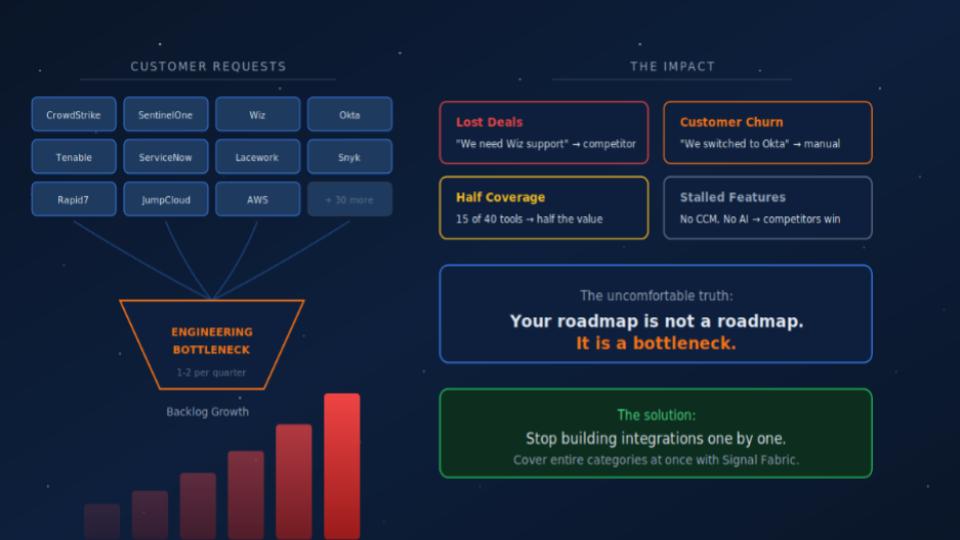
Open your product backlog. Scroll past the feature requests, the bug fixes, the technical debt. Look for the integration requests.
How many are there? Ten? Twenty? How many have been sitting there for months because you cannot justify pulling engineers off the roadmap to build them?
If you are running product at a GRC platform, integrations are probably the most frustrating part of your job. Customers want them. Sales needs them. Engineering does not have capacity. And the backlog keeps growing.
Here is the uncomfortable truth: your integration roadmap is not a roadmap. It is a bottleneck. And it is holding back your platform's growth.
The Integration Backlog Trap
- You launch with integrations for the most common tools: Okta, AWS, maybe CrowdStrike.
- Customers start asking for other tools: "Do you support SentinelOne?" "What about Wiz?"
- You add them to the backlog and prioritize based on deal size and customer count.
- Engineering builds one or two per quarter, but requests come in faster than you can ship.
- The backlog grows. Customers wait. Deals slip.
The problem is not prioritization. The problem is that you are trying to solve an exponential demand problem with linear resources.
Your customers do not use five security tools. They use forty. And they expect your platform to work with their stack, not the other way around.
Integration Gaps Become Competitive Disadvantage
When you do not have the integrations customers need, three things happen:
You lose deals.
A prospect runs CrowdStrike, Wiz, and ServiceNow. You support CrowdStrike but not the other two. They go with a competitor who has broader coverage. You never even got to demo your actual product because you failed the integration checklist.
Customers churn.
A customer adopts a new security tool. Maybe they switch from Tenable to Wiz, or add SentinelOne to their stack. Your platform does not support the new tool. Now they are doing manual work or considering alternatives.
Your product looks incomplete.
GRC platforms are supposed to give customers a complete picture of their security posture. When you only cover half their tools, you are delivering half the value. And half the value means customers question whether you are worth the price.
The Long Tail Problem
Here is a pattern you have probably noticed: 80% of integration requests are for tools you will never prioritize.
Everyone wants CrowdStrike, Okta, and AWS. Those are table stakes. But then you get requests for Lacework, Snyk, Prisma Cloud, Arctic Wolf, Rapid7, JumpCloud, Kandji, Kolide. Each one is used by a few customers or requested by a few prospects.
No single tool justifies the engineering investment. But collectively, the long tail represents a huge portion of your market. And your competitors are probably in the same boat, which means whoever figures out long tail coverage first gets a real advantage.
The math does not work when you build one integration at a time. It only works when you can cover entire categories at once.
Integrations Are Table Stakes, Not Differentiators
Let us be honest about something: integrations are not your competitive advantage.
Your competitive advantage is your workflow automation, your compliance mapping, your Continuous Control Monitoring, your user experience. The things that make your platform better than the alternatives.
Integrations are plumbing. They are necessary, but nobody chooses a GRC platform because it has a slightly better CrowdStrike integration. They choose based on what you do with the data once you have it.
So why are you spending engineering resources on plumbing instead of product differentiation?
The answer, usually, is "because we have to." But you do not have to. Not anymore.
The Bigger Problem: You Cannot Deliver Continuous Control Monitoring
Here is what the integration backlog is really costing you: the ability to deliver what your customers actually need.
Continuous Control Monitoring requires real-time evidence streams, not periodic batch pulls. It requires Normalized Evidence Signals that map cleanly to SOC 2, ISO 27001, and NIST CSF controls. It requires operational context, a shared understanding of what is actually true across your customer's security environment.
You cannot build any of this if your engineering team is spending all their time on plumbing.
And your competitors who figure this out first? They will be shipping Continuous Control Monitoring and AI-powered compliance features while you are still debugging Okta pagination.
Shifting from Integration Maintenance to Product Innovation
Imagine your next sprint planning session:
Instead of debating which three integrations to build this quarter, you are debating which product features to ship. Instead of telling sales "we will add that integration in Q3," you tell them "we already support that category." Instead of maintaining 40 vendor API connections, your team maintains one SDK.
This is what happens when you stop treating integrations as a product problem and start treating them as an infrastructure problem.
Unified APIs exist now. They connect to dozens of tools in each security category through a single API. EDR, identity, vulnerability management, cloud security. One connection per category, and you get coverage across all the major vendors in that space.
Your customers connect their tools through an embedded UI. You call an API to get Normalized Evidence Signals, not raw vendor logs. When new vendors get added, you do not have to do anything. When vendor APIs change, someone else handles the update.
And you get real-time evidence streams through the Webhook Exchange, so you can actually deliver Continuous Control Monitoring instead of point-in-time audits.
What This Means for Your Roadmap
When integrations are handled by infrastructure instead of built in-house, your roadmap changes:
The integration backlog shrinks. Not because you built everything, but because entire categories are covered at once.
Engineering capacity opens up. The engineers maintaining integrations can work on features instead.
Time to market accelerates. Supporting a new category takes days, not quarters.
Customer conversations change. "Do you support X?" becomes "What would you like us to build next?"
You can focus on differentiation. Continuous Control Monitoring. AI-powered compliance. The features that actually win your market.
Stop Managing an Integration Backlog
Your integration roadmap is not serving your customers or your product. It is a queue of requests you will never fully clear, managed by a team that should be building differentiated features.
The platforms winning in this market are not the ones with the best integrations. They are the ones who stopped building integrations and started focusing on what actually matters: the product.
Ashish Batwara
Founding Member & Chief Growth Officer
Founding Member and Chief Growth Officer at Unizo. Bridges the gap between technical architecture and customer-facing solutions. Writes about integration strategy, security infrastructure, and building products that put customers first.
Related Articles
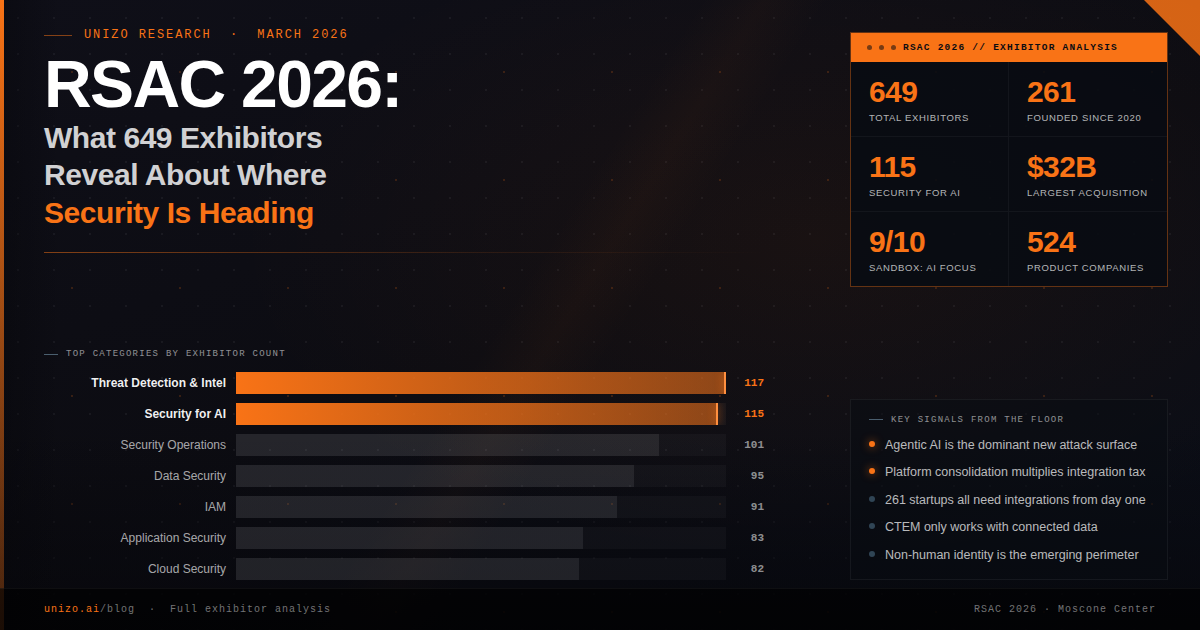
649 Security Companies Walked Into RSA 2026. None Talked About the Real Problem.
We analyzed all 649 RSA Conference 2026 exhibitors by category, company size, funding, and product space. 115 companies in Security for AI, 261 startups founded since 2020, and the one problem nobody talked about on stage. Full searchable exhibitor directory included.
Ashish Batwara
Mar 31, 2026 · 9 min read
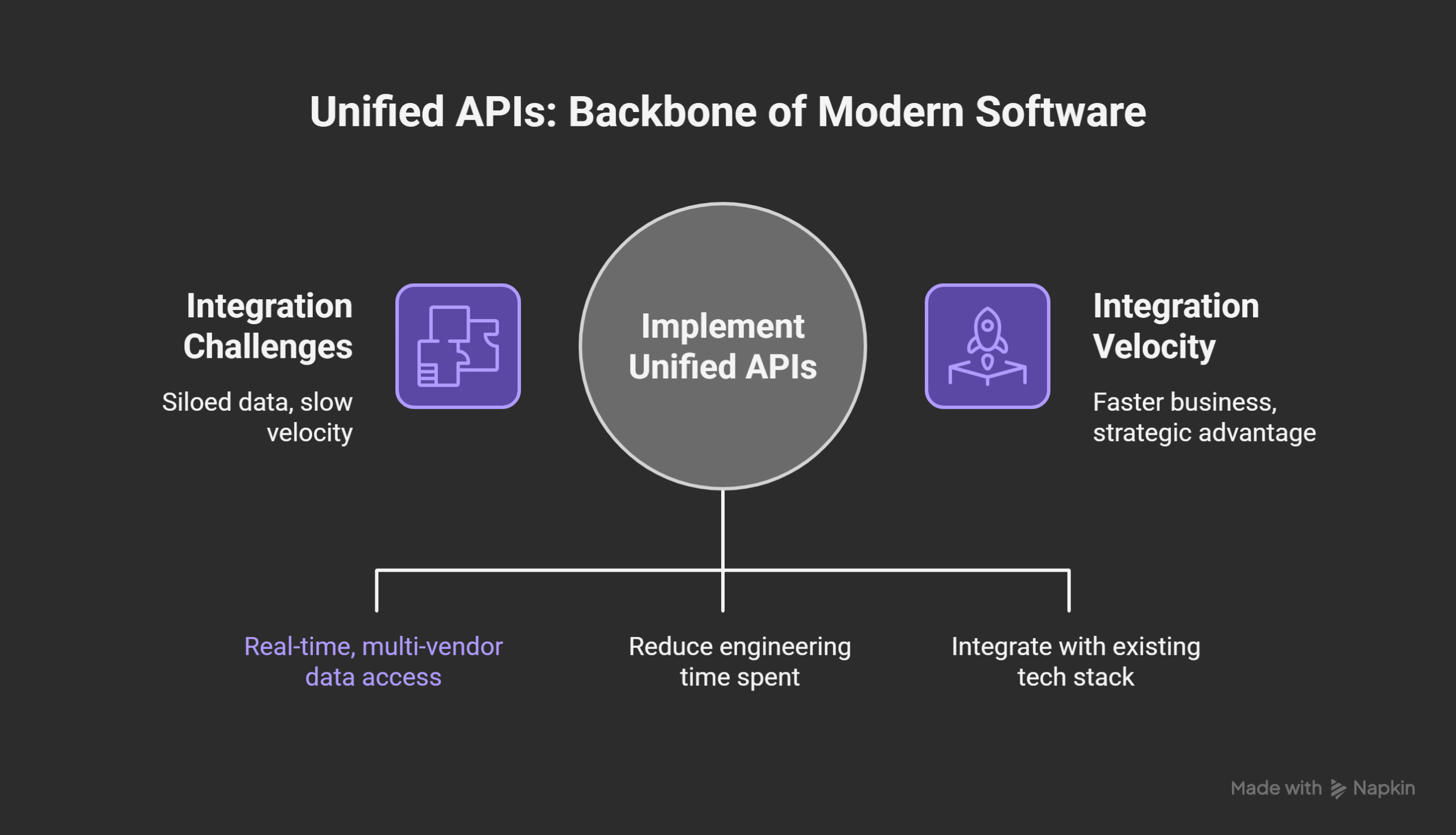
Why Unified APIs Became the Modern Software Backbone - The Evolution of Integration
If your security product relies on customer data, you already know the truth: integrations are the biggest bottleneck in your engineering roadmap. But here's the shift -- today, integrations power context, not just workflows.
Ashish Batwara
Dec 9, 2025 · 8 min read
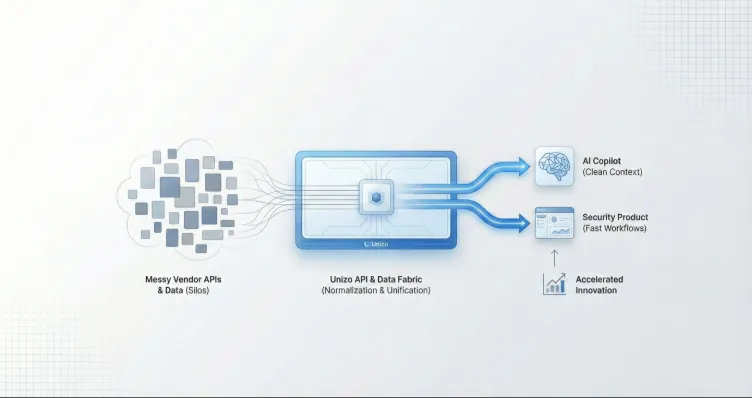
How Modern Security Products Ship 40-50 Integrations, and the AI Context Layer - In Weeks, Not Years
The fastest security companies aren't building integrations anymore. They've moved to an API & Data Fabric that handles them. Here's how teams ship 40+ integrations and full AI context in 3 weeks.
Praveen Kumar
Dec 2, 2025 · 12 min read