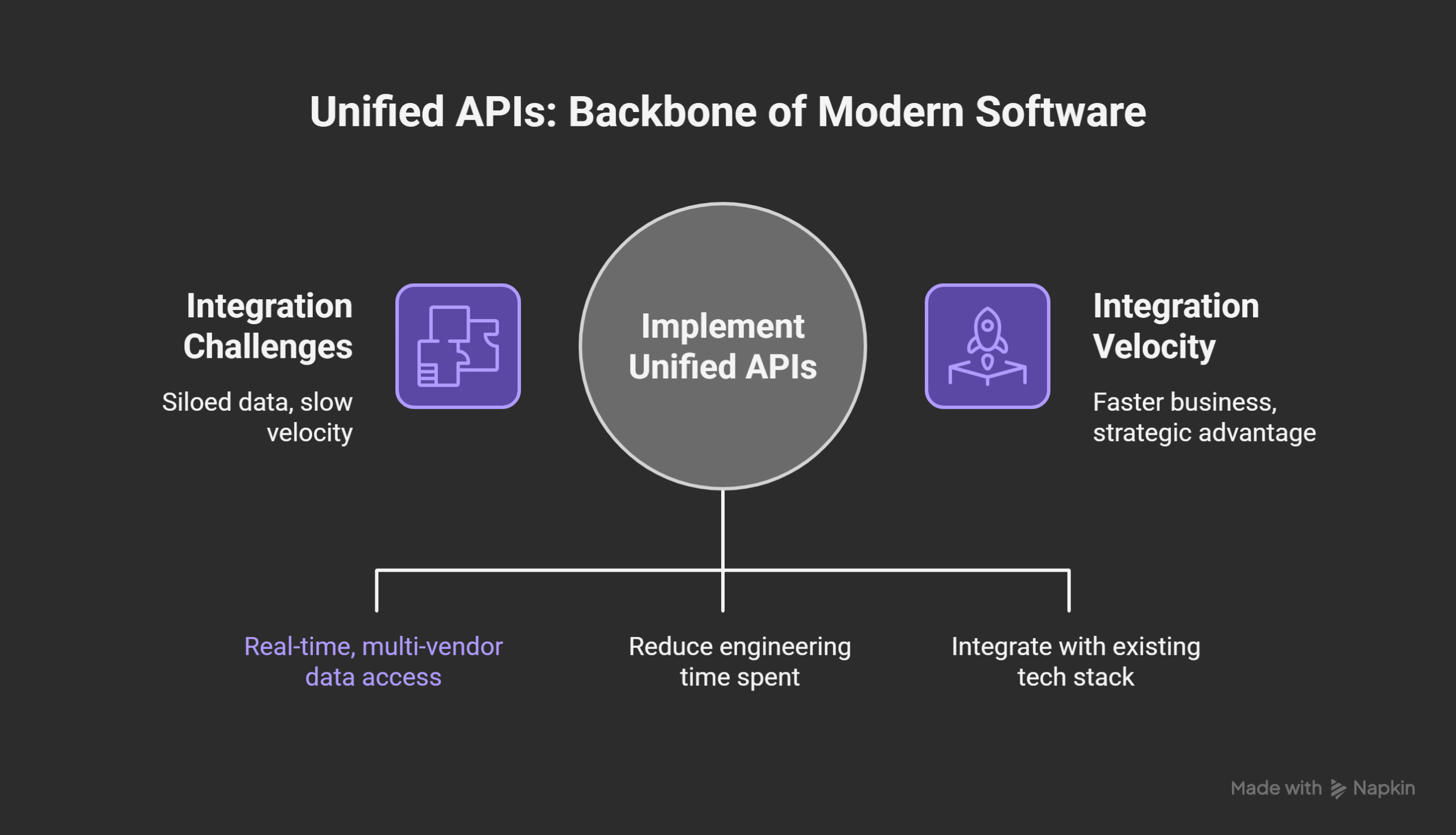
If your security product relies on customer data (alerts from EDRs, identities from IAM, finding from cloud scanners, issues from ticketing systems...), you already know the truth.
Integrations are the biggest bottleneck in your engineering roadmap.
But here's the shift happening now:
Before AI, integrations powered workflows.
Today, integrations power context, the structured, real-time, normalized information AI systems need to think, plan, and act.
Whether you're building a SIEM, GRC platform, AppSec tool, SOAR, or AI-native security product, your customers expect you to integrate with their tools.
And they expect the AI-powered features built on top of that context to just work.
1. Integration Used to Be Plumbing, Now It's Strategy
Integrations have always mattered, but in the past they didn't define a product's competitiveness. A platform could thrive with a handful of connectors.
Not anymore.
Modern enterprise buyers assume:
- Instant compatibility with their identity provider
- Full support for their ticketing system
- Event ingestion from their security tools
- Syncing with their cloud, HR, finance, or monitoring stack
Products that can't integrate deeply and quickly are disqualified before a demo.
And on the engineering side, API churn exploded. Vendors now version APIs more frequently. New fields, breaking changes, pagination updates, authentication changes, all of it lands on engineering teams already underwater.
Integrations quietly drain millions in engineering bandwidth and missed revenue, unless solved systematically.
2. Why Traditional Integration Models Hit a Wall
Every generation of integration tooling was built for its era. None were built for today's scale, API velocity, and semantic complexity.
2.1 Point-to-Point Integrations: The Exponential Trap
Direct integrations offer full control, but their complexity grows exponentially:
- 10 systems = 45 connections
- 20 systems = 190 connections
Each connection demands:
- Custom auth logic
- Custom pagination handling
- Custom error/timeout strategy
- Custom schema mapping
- Constant patching for vendor changes
This failure mode isn't about bad engineering. It's math.
2.2 ESBs: Built for a Different Era
Enterprise Service Buses introduced message hubs, transformation logic, and centralized routing. They were powerful for on-prem systems, SOAP/XML standards, and ERP-to-CRM communication.
But they don't fit a world with rapidly changing APIs, dozens of SaaS tools, real-time events, AI workloads, and JSON/REST/GraphQL heterogeneity.
The architecture mismatch became too big.
2.3 iPaaS: Great for Workflows, Weak at Normalization
iPaaS platforms democratized integration by providing workflows, triggers, and visual automation. But they struggle with multi-vendor data unification.
Each vendor's schema is different. iPaaS can connect to them, but it cannot normalize meaning across vendors.
Your workflow becomes a chain of if/else mappings, a tangle of vendor-specific transformations, and a maintenance nightmare when vendors change fields or enums.
iPaaS solved orchestration. It did not solve semantic interoperability.
3. The Core Issue: Schema Fragmentation, Not Connectivity
The real enemy of scalable integration isn't APIs, it's meaning divergence.
Vendors cannot agree on what their objects represent, how they're structured, or what they're called.
Identity Example: One Concept, Four Incompatible Schemas
- Okta: "User"
- Azure AD: "Identity"
- Google Workspace: "Account"
- Ping Identity: "Principal"
These represent roughly the same idea, a human user, but have different field names, nested structures, ID formats, enum sets, relationship models, and lifecycle states.
Multiply this fragmentation across tickets, alerts, assets, sessions, incidents, and cases, and the integration problem becomes a semantic one, not a connectivity one.
Connectivity gets data through the door. Normalization makes data usable.
This is the gap Unified APIs were designed to close.
4. What Unified APIs Actually Do (Under the Hood)
Most explanations reduce Unified APIs to "one API that connects to many systems." But the real value comes from four architectural layers that work together to handle the hardest parts of integration.
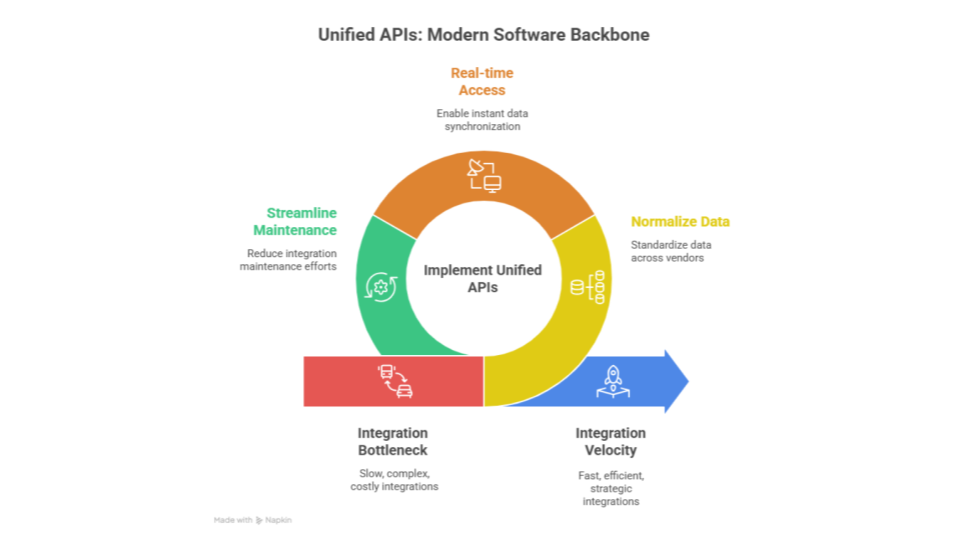
4.1 Connector Management Layer
This layer abstracts vendor operational complexity:
- OAuth + token refresh
- API key rotation
- Rate limit detection + adaptive retry
- Cursor, offset, and hybrid pagination
- Handling vendor outages and partial responses
- API version tracking
- Normalized error semantics
Think of this as the infrastructure needed to keep hundreds of brittle APIs reliable.
4.2 Semantic Normalization Layer (The Real Innovation)
This layer defines canonical schemas for each domain: Alert, User, Ticket, Asset, Group, Session.
It performs field mapping, enum harmonization, data type alignment, timestamp normalization, and relationship reconstruction.
If five vendors all represent alerts differently, this layer produces a single consistent "Alert" shape. This is what makes downstream AI, analytics, and automation possible.
4.3 Unified API Surface
This is the simplified interface developers interact with:
GET /alerts
GET /tickets
GET /users
GET /assets
The true value isn't fewer endpoints, it's that the same query logic works across all vendors.
Unified API Query (Clean & Predictable)
GET /alerts?severity=high&status=open&since=24h
Equivalent Vendor-Specific Query (Messy & Inconsistent)
GET /v2/detections?min_priority=4&state=active&last_24=true
Unified APIs simplify not just the endpoint, but the entire cognitive model.
4.4 Passthrough Layer
Because no unified schema can capture 100% of every vendor's surface area, passthrough enables raw vendor API calls, custom filters, and deep vendor-specific features.
This ensures teams don't lose expressiveness when they move to Unified APIs.
5. The Real Business Math Behind Unified APIs
The following section talks about the potential DIY integration cost.
5.1 Initial Build Cost
- 40 integrations
- 40 engineering days for each integration
- Fully-loaded engineer cost: $200K/year
= $1.23M initial build cost
5.2 Annual Maintenance
Maintenance Estimation: 80 hours per integration/year
Fix breaking change hours/year: 40 hours/breaking change assuming one breaking change per integration/year
= $461K annually
5.3 Total Cost of Ownership
- 3-Year Total: $2.6M
- 5-Year Total: $3.5M
These numbers exclude lost deals from missing integrations, support escalations, delayed AI initiatives, and customer churn due to broken connectors. If we consider these, then the true cost of ownership is much higher than the above number.
Unified APIs turn a runaway variable cost into a predictable fixed cost.
6. Unified APIs Are Becoming AI Infrastructure
LLMs and AI agents require strongly typed data, stable schemas, clear relationships, consistent enums, and real-time updates.
AI cannot infer vendor-specific semantics, reconcile misaligned object types, or patch over incompatible data structures.
Unified APIs aren't an integration shortcut, they're emerging as a prerequisite layer for enterprise AI systems.
Just as data warehouses became the backbone of BI, Unified APIs are becoming the backbone of AI.
7. Where Unified APIs Break (Honest Limitations)
Unified APIs are powerful, but not universal. They're not ideal when:
- You only need one or two integrations
- Your use case relies heavily on niche vendor-specific features
- You need workflow orchestration (iPaaS is better)
- You're deeply tied to legacy on-prem systems (ESBs still useful)
8. Conclusion: Why This Shift Was Inevitable
The rise of Unified APIs wasn't marketing. It was an architectural response to exploding SaaS ecosystems, rapid API changes, semantic fragmentation, AI requirements for structured context, and the economic burden of DIY integrations.
Connectivity is easy. Consistency is hard. Unified APIs solve consistency.
They are becoming foundational infrastructure for modern software and the AI systems built on top of it.
Unizo provides the semantic normalization and unified data foundation that modern AI systems require. Instead of wrestling with hundreds of inconsistent vendor schemas, teams get a single, predictable layer powering alerts, assets, identities, and tickets. With Unizo, integration velocity becomes AI velocity.
Comparison Table: Integration Approaches
| Approach | What It Solves | Where It Fails | Ideal Use Case | |---|---|---|---| | Point-to-Point | Full vendor control | Exponential growth, brittle, high maintenance | 1-2 high-value integrations | | ESB / Middleware | Legacy system integration, complex routing | Not cloud-native, heavy, slow | Large ERPs, on-prem systems | | iPaaS | Workflow automation, triggers, orchestration | Weak schema normalization; brittle at scale | Multi-step business workflows | | Unified API | Normalization, multi-vendor parity, scalable integrations | Not ideal for niche advanced vendor features | Products needing 10-100 integrations |
FAQs
1. What is a Unified API?
A Unified API is a single standardized API that connects to multiple third-party systems while normalizing inconsistent vendor data models, schemas, and object types into one consistent format. It removes the complexity of managing dozens of separate integrations.
2. Why are Unified APIs important for modern SaaS products?
Because modern enterprises use 130-180 SaaS tools (Zylo 2024), Unified APIs reduce integration time, maintenance overhead, schema inconsistencies, and breaking changes. They also speed up product delivery and reduce engineering workload by 30-40%.
3. How do Unified APIs differ from traditional integrations?
Traditional point-to-point integrations rely on custom logic for each vendor. Unified APIs standardize authentication, pagination, schema differences, rate limits, and error handling -- making integrations scalable, consistent, and easier to maintain.
4. What problems do Unified APIs solve?
Unified APIs address: schema fragmentation, rapid API version changes, high integration maintenance cost, multi-vendor data inconsistency, slow product launches, and poor AI model performance due to dirty or inconsistent data.
5. How do Unified APIs improve AI systems?
AI models require clean, structured, and normalized data. Unified APIs create canonical schemas, unify enums, and maintain consistent object definitions -- making them the backbone layer for AI features, automation, analytics, and agents.
6. What is semantic normalization in Unified APIs?
Semantic normalization means converting all different vendor schemas (like User, Alert, Ticket, Asset) into one unified canonical data model. This eliminates inconsistent field names, object types, and relationships across tools.
8. How much money can Unified APIs save?
Based on typical engineering costs: Initial DIY integration cost: $1.23M. Annual maintenance: $461K. 5-year TCO: $3.5M+. Unified APIs reduce this to a predictable fixed cost with much lower maintenance.
Ashish Batwara
Founding Member & Chief Growth Officer
Founding Member and Chief Growth Officer at Unizo. Bridges the gap between technical architecture and customer-facing solutions. Writes about integration strategy, security infrastructure, and building products that put customers first.
Related Articles
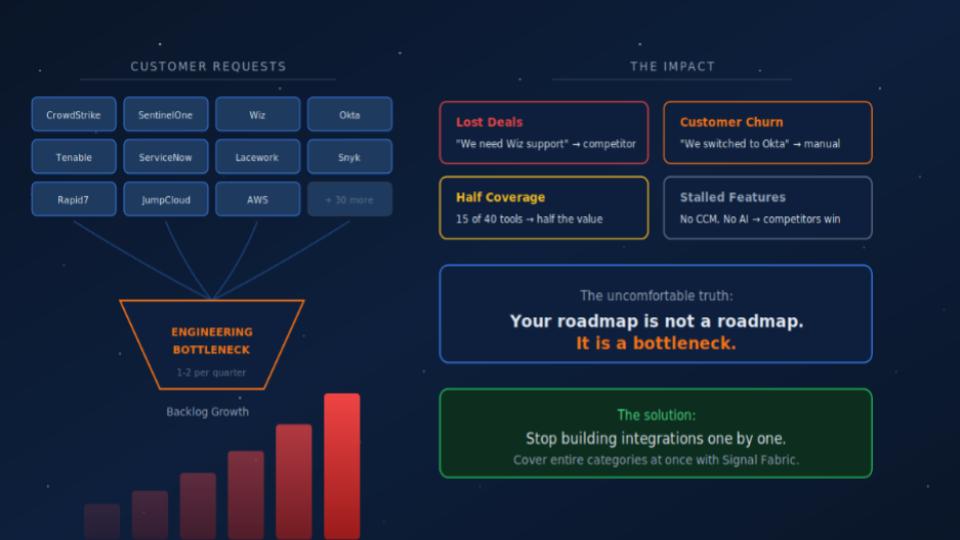
Why Your Integration Roadmap Is Holding Back Your GRC Platform
Your integration roadmap is not a roadmap. It is a bottleneck. Here is why GRC platforms that stop building integrations in-house start winning their market.
Ashish Batwara
Jan 15, 2026 · 6 min read
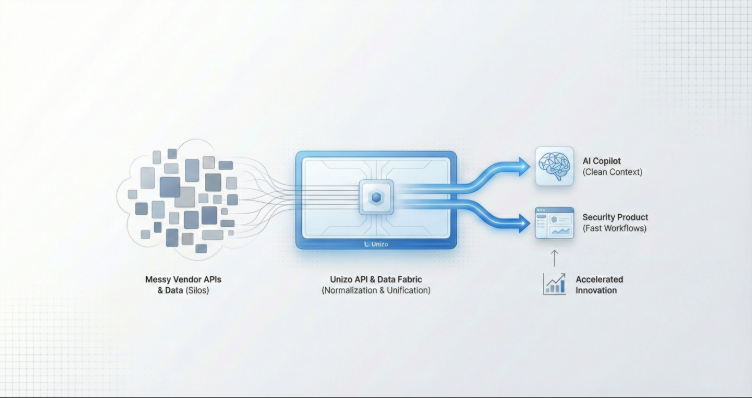
How Modern Security Products Ship 40-50 Integrations, and the AI Context Layer - In Weeks, Not Years
The fastest security companies aren't building integrations anymore. They've moved to an API & Data Fabric that handles them. Here's how teams ship 40+ integrations and full AI context in 3 weeks.
Praveen Kumar
Dec 2, 2025 · 12 min read