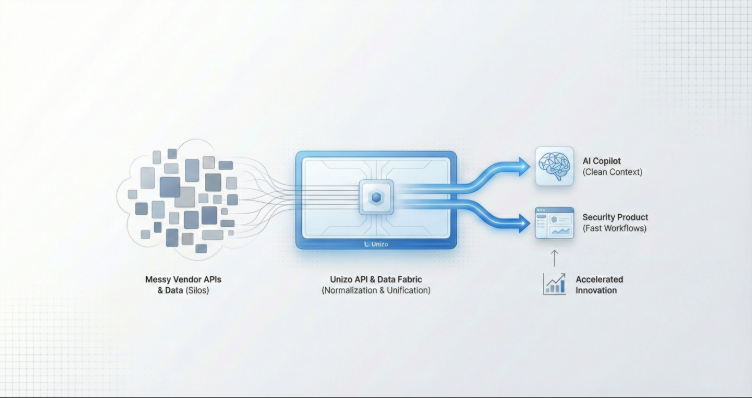
If your security product relies on customer data (alerts from EDRs, identities from IAM, finding from cloud scanners, issues from ticketing systems...), you already know the truth.
Integrations are the biggest bottleneck in your engineering roadmap.
But here's the shift happening now:
Before AI, integrations powered workflows.
Today, integrations power context, the structured, real-time, normalized information AI systems need to think, plan, and act.
Whether you're building a SIEM, GRC platform, AppSec tool, SOAR, or AI-native security product, your customers expect you to integrate with their tools.
And they expect the AI-powered features built on top of that context to just work.
Integrations are consuming the engineering cycles we don't have.
"At our scale, integrations are our slowest-moving layer. Each one still takes 6-8 weeks, customers expect dozens, competitors boast 80-100 and we simply can't hire our way out. The math breaks."-- VP of Engineering, Series B security startup.
He's right. The math does break when integrations sit on your roadmap instead of your infrastructure.
This post explains why the fastest moving security and AI vendors no longer treat integrations as product features. They rely on a pluggable API and Data Fabric - the Integration Infrastructure layer underneath both integrations and Agentic context.
Integrations vs. Context - The Shift That AI Forces
In the SaaS era, "integrations" meant "connect to Jira," "connect to Okta," "connect to ServiceNow."
In the AI era, that's no longer enough.
AI systems require Agentic Context:
- normalized identities
- unified alerts
- clean assets
- stable events
- historical, cross-tool relationships
- real-time changes
AI cannot reason without consistent context. And consistent context only comes from reliable, normalized integrations.
So while the industry still uses the term "integrations," the real requirement today is the context those integrations produce.
Integrations power connectivity and automation.
Context powers intelligence.
The Integration Wall - Why Engineering Teams Fall Behind
Security products must ingest, correlate, and act on data from dozens of systems
- CrowdStrike, SentinelOne, Microsoft Defender, Palo Alto Cortex...
- Okta, Ping, Entra, Google Workspace, Auth0...
- Tenable, Wiz, Prisma Cloud, Semgrep, Qualys...
- Jira, ServiceNow, GitHub, GitLab, ADO...
Your customers expect these connectors, and the context from them to "just work."
But here's what one integration actually costs:
The Real Engineering Cost per Integration
| Activity | Hours | % | |---|---|---| | Reading vendor documentation | 16-24 | 8% | | Building auth (OAuth, API keys, token refresh) | 24-40 | 12% | | API client (pagination, rate limits, retries) | 40-60 | 18% | | Data normalization into your schema | 40-80 | 22% | | Error handling and schema drift fixes | 40-60 | 18% | | QA, testing, and documentation | 40-60 | 18% | | Total per integration | 200-320 | ~8 weeks |
40 vendors x 8 weeks = 6+ engineer-years (before you even get to AI context modelling)
Meanwhile, your product roadmap stalls. Features get delayed. Your best engineers spend their time on plumbing instead of your core product.
This is the integration tax, and it's killing security product velocity.
Why Building Integrations Yourself starts easy, but turns into a Trap
Every team begins with the same innocent plan -- "We only need a few connectors. Let's build them."
Then customers ask for 3 more. Then 10 more. Then AI team asks for context around 20 systems.
Slowly, you are no longer "adding integrations", you are building a fragile, incomplete context fabric without meaning to.
At some point every founder or VP Eng recognizes the truth: "We accidentally became an integration company."
1. One connector becomes twenty and you inherit every vendor's mess
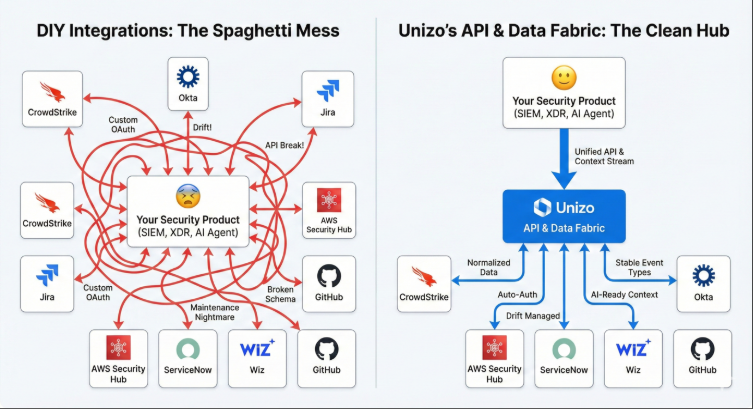
Every vendor is different
- Auth + token refresh
- Pagination + rate limits
- Webhook formats
- Schemas + naming conventions
- Silent API changes
And none of them version reliably. This is where the real cost hits and schema drift becomes a permanent tax. Your top engineers end up debugging vendor quirks instead of building products.
And AI now depends on this data, so the stakes are even higher.
2. The "Internal Abstraction Layer" That shows up later on
Eventually, someone suggests "We need an abstraction layer." Correct, but too late.
By then you already have a pile of inconsistent connectors, duplicated auth logic, conflicting schemas, messy normalization paths, tangled multi-tenant credential handling and a growing break/fix debt
An internal framework helps briefly then collapses under the same burden. Because even with abstractions, you still own all the adapters, all the drift, and all the maintenance.
Some teams had lots of bandwidth and money on hand to spend at start (yes, I am amazed on that as well) and they tried to start with an abstraction layer, but that was another game of pain and frustrations. The foundation alone takes 3-6 months.
A proper integration architecture requires semantic data models, token management and secure credential isolation, webhook handling and re-tries, multi-tenant storage, rate-limit orchestration, monitoring / tracing / logging, schema normalization. This is 500+ hours before you even write a single vendor adapter.
3. AI Breaks the DIY Model entirely
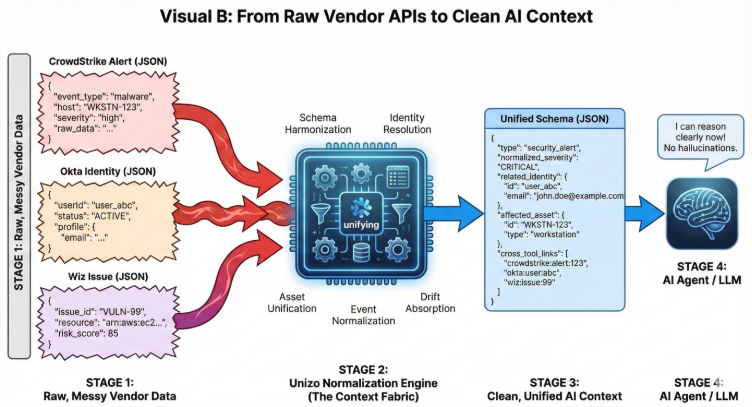
Before AI, inconsistent data was painful. Now it kills features. AI multiplies need for integrations, they need more tools and much cleaner data than human workflows ever did. And they operate at machine speed.
So inconsistent identities, drifting alert schemas, messy assets, and unpredictable events don't just cause bugs, they instantly corrupt AI reasoning.
A big misconception -- "MCP solves this for us." I hear this often. While MCP is great, the answer is no. It doesn't solve the data problem.
MCP standardizes how AI calls tools. It does not normalize vendor APIs, handle Auth, absorb schema drift, or unify data models.
In other words: MCP is the pipe, but it doesn't filter the water.
If you pour raw, messy vendor API data into an MCP server, your AI agent drinks mud.
Without a unified API & Data Fabric beneath it, your MCP tools are built on sand.
4. The DIY Endgame is always the same
Within 12-24 months, teams end up with
- Dozens of brittle connectors
- nonstop maintenance cycles
- slipping roadmap velocity
- project blocked on data quality
- growing customer pressure for "one more integration"
- engineers burned out on plumbing
The real lesson becomes obvious -- Integrations were never features. They were Infrastructure all along. And AI made that impossible to ignore.
The New Approach: Integration as Infrastructure, Context as your AI Advantage
The fastest security companies aren't "building integrations faster." They've stopped building integrations altogether.
They treat integrations as infrastructure, not features; and they run that infrastructure on a dedicated API & Data Fabric.
This layer gives them:
- unified category-level APIs
- real-time, normalized events
- automatic schema-drift absorption
- isolated multi-tenant credentials
- consistent models that AI agents can trust
- safe, governed actions across tools
It's the foundation beneath their workflows and the context layer beneath their AI.
This is exactly what Unizo provides.
Integrate once. Gain access to dozens of enterprise systems across Identity, EDR, Cloud, AppSec, Ticketing, and more with clean, normalized context built in.
This isn't "integration as a feature." This is context as infrastructure.
How Teams Ship 40+ Integrations and Full AI Context - in 3 Weeks
The breakthrough with Unizo isn't "doing integrations faster." It's eliminating integration work entirely and replacing it with a stable, scalable context fabric.
Here's what adoption actually looks like
Phase 1 -- Embed the Fabric (Hours, Not Weeks)
Teams integrate Unizo in under a day
Install SDK -> enable categories -> embed Connect UI -> call Unified APIs.
Instantly gain 40+ integrations, not as connectors; but as normalized context sources.
Phase 2 -- Build Product Logic on Unified Context (1-2 Weeks)
Develop directly on:
- Unified schemas (Alert, Identity, Asset, Vulnerability)
- real-time semantic events (Alert.created, User.deactivated)
- cross-tool relationships
- category-level semantics
No vendor-specific code. No OAuth handling. No re-normalization.
This is the shift from plumbing to product.
Phase 3 -- Turn On AI Context (Days)
AI immediately gets:
- consistent identities
- clean assets
- normalized alerts
- unified relationships
- stable event types
- MCP-ready actions
LLMs finally receive clean, consistent inputs instead of vendor chaos.
Phase 4 -- Roll Out to Customers (Remainder of Week 2-3)
Enable Connect UI -> validate flows -> ship features backed by:
- 100s of available integrations
- full context fabric
- real-time event mesh
- enterprise-grade multi-tenancy
All without writing a single vendor-specific connector.
Build vs Buy: Engineering Economics
The difference isn't incremental. It's an order-of-magnitude.
Table 2: Build Yourself vs. Use Unizo (40 Integrations)
| Metric | Build Yourself | Use Unizo | |---|---|---| | Time to first end-to-end integration | 8 weeks | 1-2 weeks | | Time to 40 integrations | 12+ months | 3 weeks | | Engineering hours | 12,000+ hours | 160 hours | | Engineers required | 6+ Engineers | 1-1.5 Engineers | | Ongoing maintenance | Your team | Unizo handles it | | Schema drift handling | Your team | Unizo handles it | | Adding vendor #41 | 8 weeks | Already available |
Time savings: 95%+ faster.
Engineering effort: 99% lower.
Context clarity: exponentially higher
Why Security and AI Products Choose Unizo
Unizo gives modern security products the context layer they need:
- Semantic normalization across Alerts, Users, Assets, Tickets, Findings
- Real-time normalized event mesh
- AI-ready schemas with clean, reliable relationships
- Automatic schema drift absorption
- Enterprise-grade multi-tenancy (BYOK, SOC 2 Type II, isolation, audit trails)
- Governed, type-safe actions (MCP-ready)
- Purpose-built for security, GRC, AppSec, DevOps, and AI
Security and AI products don't just need connections, they need consistent, real-time context across identity, endpoints, cloud, code, and workflows.
Unizo is the API & Data Fabric built for exactly this.
Is Unizo Right for Your Product?
Unizo is the right fit if your product depends on customer data across identity, endpoints, cloud, code, tickets, or vulnerabilities and more tools and you want to power AI-driven features without drowning in integration work. It's built for teams building:
- SIEM / SOAR / XDR platforms -- Ingest alerts from multiple EDRs, enrich with identity + asset context, and trigger cross-vendor actions.
- GRC & compliance automation tools -- Pull evidence from IAM, cloud, code, and assets; validate controls like MFA, least privilege, and drift.
- AppSec & code security platforms -- Fetch code from SCM, aggregate scanner findings, and create/update fix tickets automatically.
- Cloud & infrastructure security products -- Inventory resources across AWS/Azure/GCP, correlate misconfigs, and power remediation workflows.
- Identity security & access governance tools -- Normalize users/groups across Okta, Entra, Google, Ping; detect orphaned, inactive, or risky accounts.
- EDR/XDR & device-centric tools -- Unify device inventories, correlate alerts, and act on hosts consistently across vendors.
- AI copilots & agentic security workflows -- Provide LLMs with clean identity-asset-alert context and safe, governed actions they can execute.
- ITSM, ticketing, & workflow automation platforms -- Sync issues, alerts, and user/device data across Jira, ServiceNow, GitHub/GitLab, Zendesk, and more.
- Any product needing 20+ integrations -- Deliver reliable, normalized, AI-ready context without building or maintaining vendor plumbing.
If your roadmap is slowed by integrations, or your AI is limited by inconsistent data, Unizo is the missing foundation.
Stop Building Integrations. Start Shipping Product.
The VP I spoke with had a simple question: "How are other teams shipping dozens of integrations while we struggle to ship four?"
The truth: They're not building integrations anymore. They've moved to an API & Data Fabric that already handles them.
Because your engineering team shouldn't be writing OAuth flows, chasing schema drift, or stitching together vendor payloads.
They should be building:
- the security features that differentiate you
- the AI that powers insight
- the workflows customers depend on
Let Unizo handle the plumbing -- the normalization, the drift, the events, the context.
Your job is to ship product. Unizo's job is to make sure nothing beneath it slows you down.
FAQs
What if a vendor isn't supported?
We cover 150+ vendors across EDR, Identity, Ticketing, Cloud, and more. If you need one we don't have, we can add it quickly.
Does Unizo store customer data?
No. We process data in real-time without storing it. Credentials are isolated per tenant, and we support BYOK. SOC 2 Type II compliant.
What happens when a vendor changes their API?
We update our adapters. Your product stays stable -- no engineering work on your side.
Does Unizo work with AI agents?
Yes. We provide normalized schemas and real-time context that LLMs can reason over reliably. MCP support included for governed actions.
How long does it take to integrate with Unizo?
Most teams integrate in under a day. You call our unified APIs, drop in the Connect UI, and get access to 40+ integrations immediately.
What's "semantic normalization"?
Different vendors use different names for the same thing -- CrowdStrike says "detection," SentinelOne says "threat," Defender says "incident." Unizo maps all of these to a single "Alert" model. Same for Users, Assets, Tickets, and more.
What exactly is Unizo?
Unizo is a Unified API and Data Fabric for security products. We provide unified APIs, normalized data models, real-time events, and AI-ready context across 150+ vendors -- so your team ships product, not plumbing.
Praveen Kumar
CEO & Co-founder
CEO and Co-founder of Unizo. Building the integration fabric for security, DevOps, and AI platforms.
Related Articles
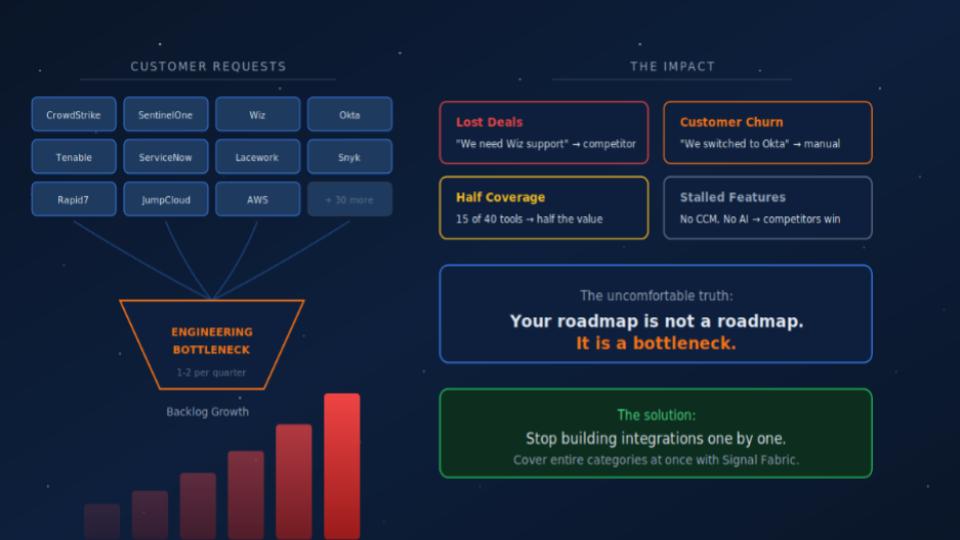
Why Your Integration Roadmap Is Holding Back Your GRC Platform
Your integration roadmap is not a roadmap. It is a bottleneck. Here is why GRC platforms that stop building integrations in-house start winning their market.
Ashish Batwara
Jan 15, 2026 · 6 min read
Why Unified APIs Became the Modern Software Backbone - The Evolution of Integration
If your security product relies on customer data, you already know the truth: integrations are the biggest bottleneck in your engineering roadmap. But here's the shift -- today, integrations power context, not just workflows.
Ashish Batwara
Dec 9, 2025 · 8 min read