Introduction: The Digital Backbone of Modern Software
In today's hyperconnected world, API integration has become the invisible infrastructure powering nearly every digital interaction. From booking flights online to processing payments, from syncing calendar events to pulling social media feeds -- API integrations enable disparate software systems to communicate seamlessly and in real time.
In 2025, over 83% of enterprise workloads rely on APIs for data communication and automation, according to Postman's 2024 State of the API Report. As organizations scale globally and adopt cloud + AI architectures, API integration has evolved from a technical convenience to a strategic imperative -- driving efficiency, enabling interoperability, and accelerating innovation.
This comprehensive guide explores what API integration means, how it works, the different types available, real-world examples across industries, common challenges, and emerging trends shaping the future of connected systems.
What Is API Integration?
API Integration is the process of connecting two or more software applications through their Application Programming Interfaces (APIs) to enable automated data exchange, functionality sharing, and real-time communication. In simpler terms, API integration allows your software systems to work together instead of operating in isolation.
Simple Example: Flight Booking
When you book a flight on a travel aggregator like Expedia, the platform doesn't store airline data on its own servers. Instead, it connects directly to multiple airlines' systems through APIs, fetching real-time seat availability, pricing, and booking status. That seamless experience -- where you view live flight data from different carriers in seconds -- is powered by API integrations working behind the scenes.
Enterprise Example: Security Tool Integration
Instead of writing custom integrations for CrowdStrike, SentinelOne, Microsoft Defender, and Carbon Black separately, a security operations team can use unified API platforms to pull alerts, device posture, and behavioral events through a single normalized schema. This approach eliminates the need to manage tool-specific quirks like pagination, retries, rate limits, and API version differences, allowing security analysts to build comprehensive incident dashboards and automated response workflows with significantly less engineering overhead.
Why API Integration Matters in 2025
As businesses scale globally and rely increasingly on cloud-based applications, API integration has transitioned from being a technical feature to becoming a strategic advantage. Companies without robust API integration strategies face data silos, operational delays, inconsistent information across systems, and scalability bottlenecks.
Key Statistics:
- Global API Economy Growth: The API economy is projected to surpass $8.2 billion by 2027, growing at a 14.1% CAGR (MarketsandMarkets)
- AI-Driven Integrations: 67% of companies now use AI + APIs to power automation (Gartner, 2024)
- Development Efficiency: API-based integration can reduce software development timelines by up to 60%
- Scalability & Interoperability: Businesses scale faster when core systems -- CRM, payment processing, analytics, inventory management -- communicate effortlessly
How Does API Integration Work?
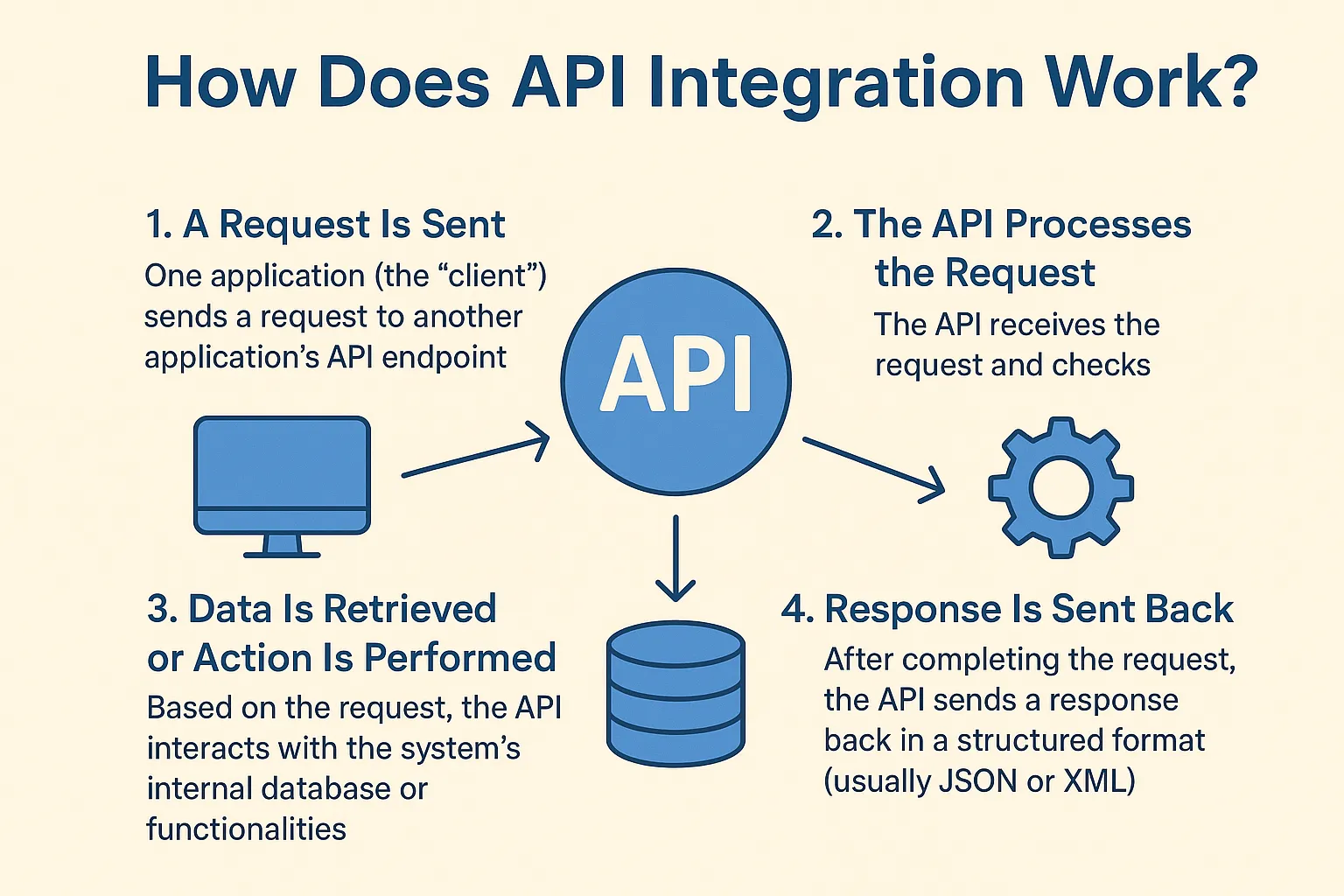
At its core, API integration functions like a structured conversation between two software systems. One system makes a request for data or functionality, and the other provides a response -- enabling seamless communication and automation between platforms.
Step-by-Step Process:
1. API Request (Initiation)
The process begins when System A sends a request to System B using a predefined API endpoint. For example, if a CRM needs to pull customer details from a database, it sends a request like GET /api/v1/customers. This tells the target system exactly what data is being requested.
2. Authentication (Security Verification)
Before any data is shared, the receiving system verifies that the requester is legitimate. This is handled through API keys, OAuth tokens, or JWT (JSON Web Tokens) -- which act as digital credentials to verify identity and maintain security. This step prevents unauthorized access and protects sensitive business data.
3. Processing the Request (Backend Logic)
Once verified, System B processes the incoming request. For instance, it may fetch customer information, verify a transaction, or update a record based on the command received. This step involves server-side logic, data validation, and interaction with databases or other integrated services.
4. API Response (Data Delivery)
After processing, System B returns a response to System A, usually formatted in JSON (JavaScript Object Notation) or XML (Extensible Markup Language). This ensures the information is structured, lightweight, and easily readable by both machines and developers.
5. Automation Trigger (Action Execution)
Finally, the received data or response triggers automated actions in System A. For example, updated payment data might automatically sync with accounting software, or a new lead captured on a website might auto-populate a CRM system. This eliminates manual updates and ensures real-time synchronization across business tools.
Real-World Example: Payment Processing
Consider a payment API integration between Stripe and an e-commerce platform. When a customer completes a purchase via Stripe, the API automatically sends a real-time confirmation to the platform's system. This integration ensures that transaction details, payment status, and customer data are instantly reflected in the merchant's dashboard -- without any manual intervention. The result: faster reconciliations, accurate data flow, and an enhanced customer experience.
Types of API Integration
Different integration scenarios call for different API architectures. Understanding the types of API integrations available helps organizations choose the right approach for their specific needs.
1. REST API Integration
REST (Representational State Transfer) is the most widely adopted API architecture in modern software development. REST APIs use standard HTTP methods (GET, POST, PUT, DELETE) and are stateless, making them flexible, scalable, and easy to implement. They're ideal for web and mobile applications that need to retrieve or manipulate data across the internet.
2. SOAP API Integration
SOAP (Simple Object Access Protocol) is a protocol-heavy integration standard that was popular in enterprise systems before REST became dominant. SOAP APIs are still widely used in banking, telecommunications, and government systems where strict security, ACID compliance, and formal contracts (WSDL) are required. While more complex than REST, SOAP provides built-in error handling and transaction management.
3. GraphQL API Integration
GraphQL is a modern, developer-friendly query language that allows clients to request exactly the data they need -- nothing more, nothing less. Unlike REST, which often requires multiple endpoints for complex data structures, GraphQL uses a single endpoint and enables precise data fetching. This reduces over-fetching and under-fetching problems, making it particularly valuable for mobile applications and complex frontend requirements.
4. Webhook-Based Integration
Webhooks are event-driven, lightweight integrations that push data to applications when specific events occur, rather than requiring constant polling. For example, when a new customer signs up, a webhook can instantly notify your CRM, email marketing platform, and analytics tools. Webhooks are efficient for real-time notifications and reduce unnecessary API calls.
5. AI/ML API Integration
AI and machine learning APIs connect artificial intelligence models (such as OpenAI's GPT, Google Cloud AI, or Amazon Rekognition) to business workflows. These integrations enable predictive automation, natural language processing, image recognition, and intelligent decision-making within existing applications. Companies are increasingly using AI API integrations to automate customer support, analyze sentiment, and generate content.
6. Third-Party Integration Platforms (iPaaS)
Integration Platform as a Service (iPaaS) solutions like Zapier, MuleSoft, and Dell Boomi provide pre-built connectors and workflows that simplify API integration between popular applications. These platforms are particularly useful for non-technical teams who need to connect cloud applications without writing code.
7. Database API Integration
Database APIs allow applications to query, update, and manage data stored in databases directly through API calls. Examples include Firebase Realtime Database, MongoDB Atlas, and AWS DynamoDB. These integrations are essential for applications that need direct, programmatic access to structured data storage.
8. Unified API Integration
Unified API integration involves using a single, standardized API to connect with multiple applications and services within specific tool categories. Instead of building separate integrations for each vendor (e.g., integrating with CrowdStrike, SentinelOne, Microsoft Defender, and Carbon Black individually), unified APIs provide a normalized schema that abstracts vendor differences, enabling developers to integrate once and gain access to multiple providers within a category. This approach streamlines the integration process, reduces complexity, and ensures consistency across different systems.
Example: A cybersecurity platform uses Unizo.ai's unified APIs to connect with multiple security tool categories -- EDR/XDR, SIEM, Identity providers, and Vulnerability Management systems. Unizo's category-based unified APIs allow companies to access normalized, real-time data from various security solutions through a single, standardized interface. This approach simplifies integration, reduces engineering overhead by eliminating the need to manage pagination, rate limits, and API versioning for each individual vendor, and accelerates time-to-market for new integrations.
Real-World API Integration Examples
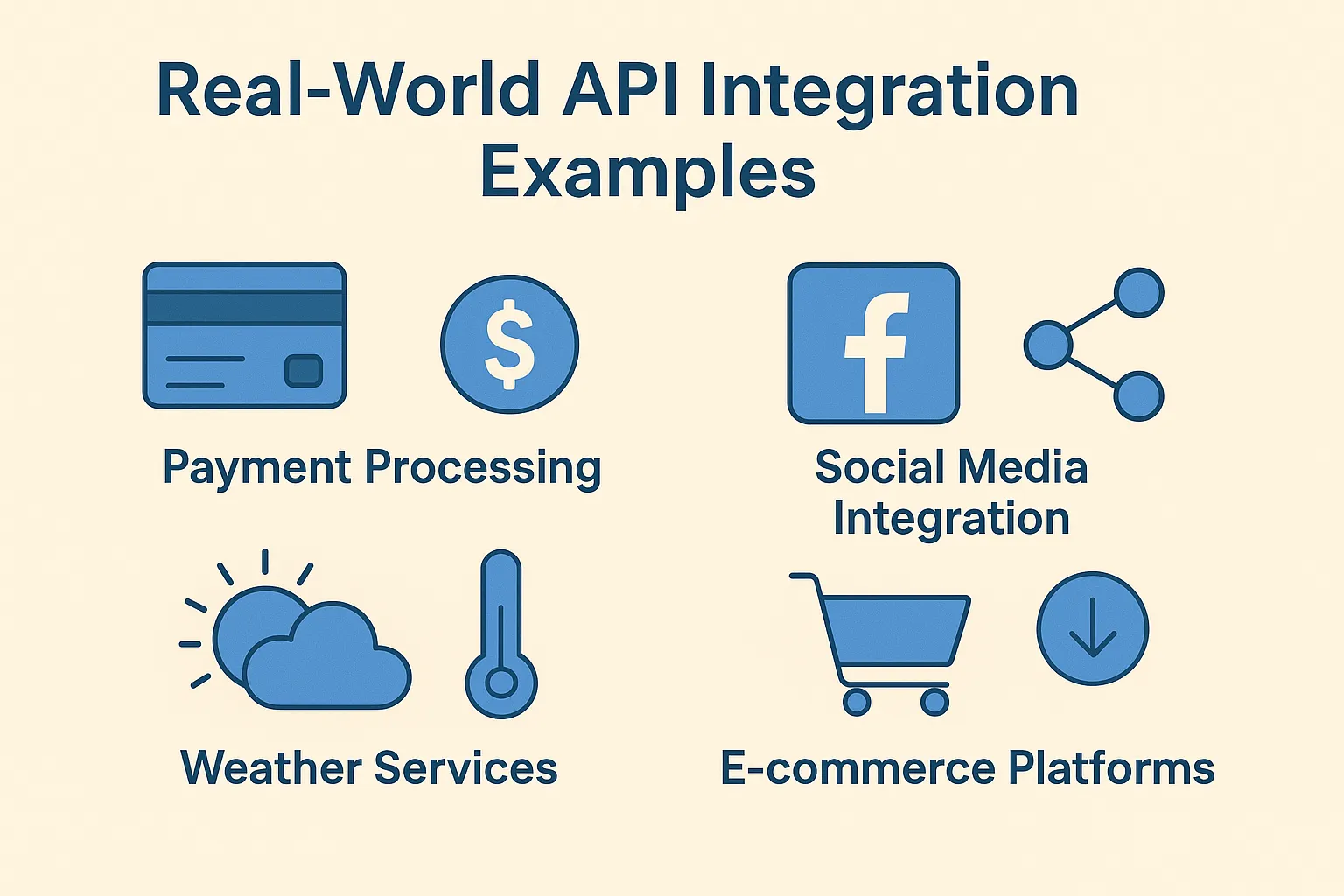
API integrations power countless everyday experiences across industries. Here are practical examples demonstrating how different sectors leverage API integration:
E-Commerce & Retail
- Payment Processing: Shopify integrates with Stripe, PayPal, and Square APIs for secure checkout experiences
- Inventory Management: Real-time stock synchronization between online stores and warehouse management systems
- Shipping & Logistics: FedEx and UPS APIs provide tracking information and shipping rates directly in e-commerce platforms
Financial Services
- Open Banking: Plaid APIs enable apps to securely connect to users' bank accounts for balance checks and transactions
- Investment Platforms: Robinhood and similar platforms use stock market APIs for real-time pricing and trade execution
- Compliance & Verification: KYC (Know Your Customer) APIs automate identity verification for regulatory compliance
Healthcare
- Electronic Health Records (EHR): FHIR APIs enable secure patient data exchange between healthcare providers
- Telemedicine: Integration between video conferencing APIs and appointment scheduling systems
- Pharmacy Systems: Prescription data flows seamlessly between doctors, pharmacies, and insurance providers
Marketing & Customer Engagement
- CRM Integration: Salesforce APIs connect with marketing automation tools like HubSpot and Marketo
- Social Media: Automated posting and analytics through Facebook, Twitter, and LinkedIn APIs
- Email Campaigns: Mailchimp and SendGrid APIs enable targeted email automation based on user behavior
Cybersecurity & IT Operations
- Security Tool Integration: Organizations use unified API platforms to access normalized, real-time data from multiple security tools within categories (EDR/XDR, SIEM, Identity), enabling centralized dashboards and workflows without managing tool-specific integration complexity
- Incident Response Automation: Security orchestration platforms use APIs to automatically isolate compromised devices, block malicious IPs, and create tickets in ticketing systems
- Threat Intelligence: Feeds from providers like VirusTotal and AlienVault integrate directly into security tools for real-time threat detection
Travel & Hospitality
- Booking Aggregators: Kayak and Booking.com use airline and hotel APIs for live availability and pricing
- Maps & Navigation: Google Maps API powers location services in ride-sharing and delivery apps
- Review Platforms: TripAdvisor APIs display ratings and reviews directly on hotel websites
Common Challenges in API Integration
While API integration delivers tremendous value, it also comes with technical and operational challenges that organizations must address:
1. Security Vulnerabilities
Unsecured API endpoints, weak authentication mechanisms, and improper access controls can expose sensitive data to breaches. Organizations must implement OAuth 2.0, API keys, rate limiting, and encryption to protect against unauthorized access and attacks.
2. Version Control Issues
When third-party APIs update their versions, existing integrations can break if proper versioning strategies aren't in place. Maintaining backward compatibility and monitoring API changelogs are essential to prevent unexpected disruptions.
3. Rate Limiting & Performance
Many APIs impose rate limits to prevent abuse, which can throttle high-volume applications. Additionally, latency issues can affect user experience when multiple API calls are required. Implementing caching strategies, request queuing, and asynchronous processing helps mitigate these problems.
4. Data Inconsistency Across Systems
Different systems often use different data formats, field names, and structures. Without proper data transformation and normalization, integrations can lead to inconsistent or incorrect information flowing through the organization.
5. Lack of Standardization
Each vendor may design APIs differently, leading to complex integration landscapes where teams must manage multiple authentication methods, data formats, and error-handling approaches. Unified API platforms help by providing standardized interfaces across multiple vendors within specific tool categories.
Solutions & Best Practices
Organizations can overcome these challenges through:
- API Management Platforms: Solutions like Kong, Apigee, and AWS API Gateway provide centralized control, monitoring, and security
- Unified API Platforms: Category-based unified APIs simplify integration by providing normalized schemas across multiple vendors, reducing engineering complexity
- Real-Time Monitoring: Built-in analytics dashboards track API performance, error rates, and usage patterns
- Automated Error Handling: Retry logic, circuit breakers, and AI-based anomaly detection ensure resilient integrations
- Comprehensive Documentation: Clear API documentation with examples accelerates developer onboarding and reduces integration errors
The Future of API Integration: 2025 and Beyond
API integration continues to evolve rapidly, driven by advances in artificial intelligence, cloud computing, and the growing demand for real-time data exchange. Here are key trends shaping the future:
AI-Powered Integration
By 2027, AI-driven API integration platforms are expected to handle 80% of data interoperability tasks. Machine learning algorithms will automatically map data fields, suggest optimal integration patterns, detect anomalies, and predict potential failures before they impact operations.
Low-Code/No-Code Integration
The democratization of API integration continues as low-code and no-code platforms empower business users to build integrations without deep technical expertise. This shift accelerates digital transformation and reduces dependency on IT departments for routine integration tasks.
Event-Driven Architectures
Organizations are increasingly adopting event-driven architectures where systems react to real-time events rather than polling for updates. This approach, powered by webhooks and message queues, enables more responsive and efficient integrations.
API Security & Governance
As API usage proliferates, security and governance become paramount. Zero-trust architectures, API gateways with built-in threat detection, and comprehensive audit trails will be standard requirements for enterprise API integrations.
Industry Projections
By 2027:
- Over 1 billion APIs will be in active enterprise use globally
- The API management market will exceed $15 billion in annual revenue
- 75% of organizations will adopt API-first development strategies
- GraphQL adoption will surpass 50% among modern web applications
Conclusion: Building Connected Digital Ecosystems
API integration has evolved from a backend technical requirement into the fundamental architecture enabling digital transformation. Whether you're automating workflows, building customer-facing applications, or connecting enterprise systems, understanding and implementing effective API integration strategies is essential for competitive advantage in 2025 and beyond.
From REST and GraphQL to AI-powered integrations and event-driven architectures, the landscape continues to expand with new possibilities. Organizations that invest in robust API integration infrastructure -- with proper security, monitoring, and governance -- position themselves to innovate faster, scale efficiently, and deliver superior customer experiences.
As the complexity of integration needs grows, platforms that simplify multi-vendor connectivity, normalize disparate data schemas, and provide unified interfaces will become increasingly valuable. The future belongs to organizations that embrace API-first thinking and build truly connected digital ecosystems.
FAQs
Q1. What is API Integration?
API Integration is the process of connecting two or more software applications through their Application Programming Interfaces (APIs) to enable automated data exchange, real-time communication, and functionality sharing across systems.
Q2. How does API Integration work?
API integration works through a request-response cycle: System A sends an authenticated request to System B via an API endpoint, System B processes the request and returns structured data (usually JSON or XML), and System A then uses that data to trigger automated actions or update its own systems.
Q3. What are the main types of API integrations?
The main types include REST APIs (most common, flexible), SOAP APIs (enterprise-grade, secure), GraphQL APIs (efficient data fetching), Webhook-based integrations (event-driven), AI/ML APIs (intelligent automation), database APIs (direct data access), and unified APIs (category-based standardization).
Q4. What are common use cases for API integration?
Common use cases include automating repetitive processes, synchronizing data across systems in real-time, connecting cloud applications (CRM, ERP, marketing tools), embedding payment processing or analytics capabilities, integrating third-party services, and building modular, scalable software architectures.
Q5. What challenges should I expect with API integration?
Common challenges include managing security vulnerabilities, handling API version changes, dealing with rate limits and latency, ensuring data consistency across different systems, and navigating the lack of standardization across vendor APIs. Using API management platforms and unified integration solutions can help address these challenges.
Q6. How do I ensure API integration security?
Implement OAuth 2.0 or JWT for authentication, use HTTPS encryption for data transmission, enforce rate limiting to prevent abuse, validate and sanitize all input data, maintain comprehensive access controls, regularly update API versions, monitor for suspicious activity, and conduct security audits on integrated systems.
Q8. What are unified APIs and how do they help?
Unified APIs provide a single, standardized interface to connect with multiple vendors within specific tool categories (like EDR/XDR, Identity, or Ticketing systems). Instead of building separate integrations for each vendor, developers integrate once with the unified API and gain access to multiple providers through a normalized schema. This approach reduces integration complexity, accelerates development, and simplifies maintenance.
Sudhanva Gnaneshwar
CTO & Co-founder
CTO and Co-founder of Unizo. Building the unified API and data fabric powering next-generation integrations.
Related Articles
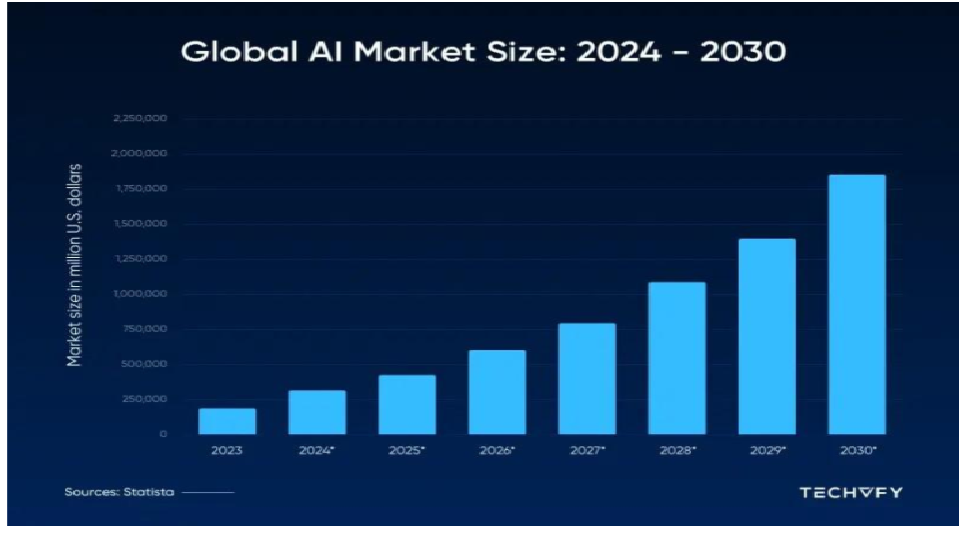
APIs: The Strategic Nexus of AI, Security, and Efficiency
The future of business is intelligent. Whether you're building a smart ring, a contextual meta glass application, or autonomous helper robots, the seamless integration of AI is the differentiator -- and APIs are the foundation.
Ramchandra Jayateerth Koty
Jan 14, 2026 · 6 min read
The Hidden Cost of Building Security Integrations In-House
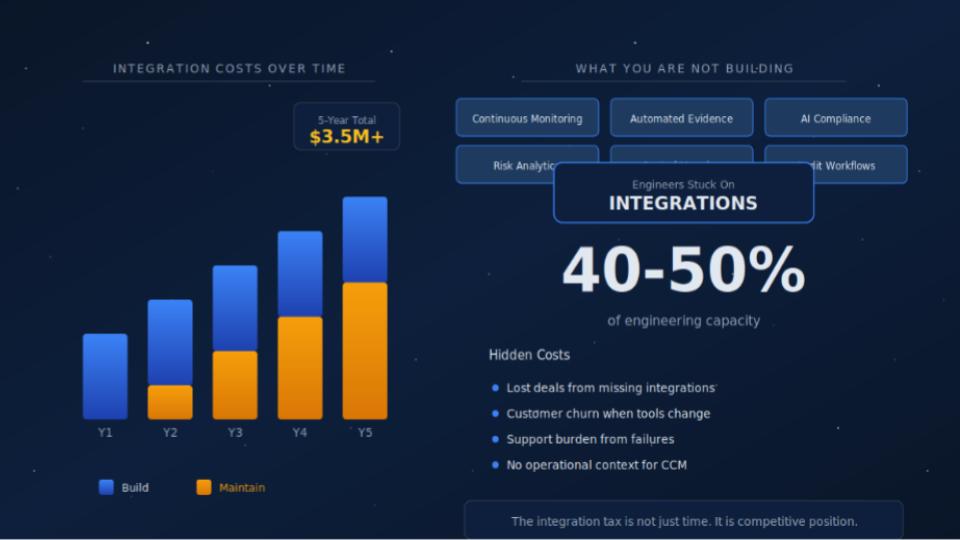
Your sales team just closed a deal. Then the customer asks: 'Do you integrate with CrowdStrike?' This is the integration tax -- and most GRC platforms underestimate how much it actually costs.
Ashish Batwara
Jan 14, 2026 · 6 min read
Building a Multi-Tenant Integration Layer: Build vs. Buy
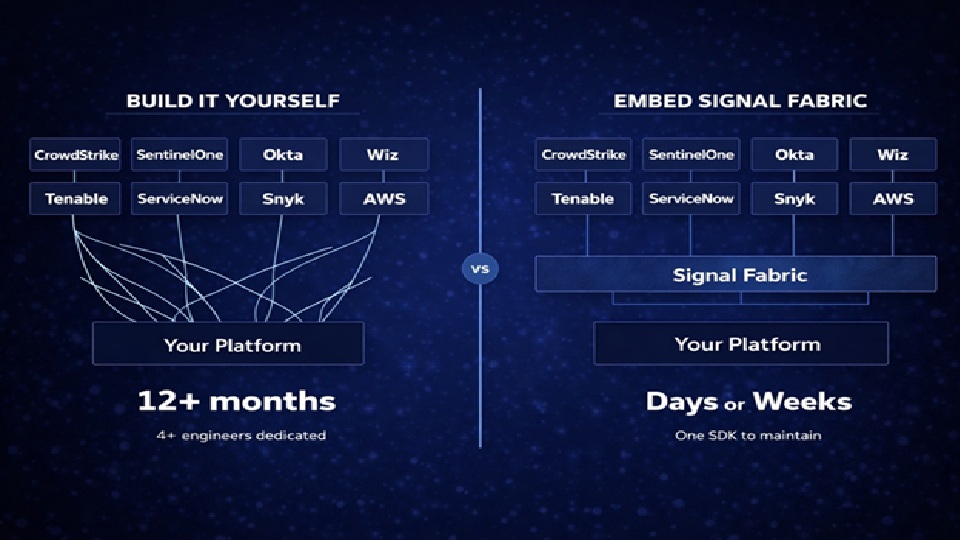
You have been asked to build integrations for your GRC platform. Seems straightforward: call some APIs, normalize the data, display it in the UI. Except it is not a few weeks. And it is not straightforward.
Ashish Batwara
Jan 13, 2026 · 9 min read